All Hands on Deck
 ...
...
All Hands on Deck

Sometime after 3pm October 12, 1678, Sir Edmund Bury Godfrey (a.k.a Sir Edmundberry, Edmund Berry, etc.) met his untimely demise. His body was found in a ditch 5 days later, run through with his own sword and bearing strangulation marks around his neck, miles away from his London home and office in a lovely location known as Primrose Hill. How he got there, and whether he was actually murdered remains to this day an unsolved mystery. Precious little blood and ink would likely have been spilled about this unfortunate event had it not been swept up in a wave of anti-Catholic hysteria with the so-called "Popish Plot," a sham conspiracy theory in 1678 fueled by popular print genres: the broadside ballad, cartoons, and playing cards. The Restoration period experienced a (mis)information explosion not unlike our own pervasive technologies and social media, with comparable effects.
In Monarchy, Print Culture, and Reverence in Early Modern England (2020) Wake Forest University historian Stephanie Koscak (!) argues:
Plot cards and genres with topical images of graphic satire with which they overlapped... involved readers/viewers in the act of narrating conspiracy, perpetuating the fiction that all events, far from being coincidental or contingent, were part of a hidden grand design—a claim I support by drawing parallels with Scott McCloud’s arguments about the ways in which modern comic books anticipate readers in the production of meaning...
McCloud is a comic artist and theorist who explains how graphic media leave empty spaces (the "gutter") between panels that readers fill with their own imagination. The space between facts is critical to Koscak's study, and she argues that it informed how readers viewed print media of the time, but also how they thought about public events. Then she takes it a step further, into the random combinations of playing cards:
The Popish Plot decks, as others have observed, lack an obvious order, such that events are not depicted chronologically by suit, instead “requir[ing] the player (or the game itself) to impose one.” At the same time, the Horrid Popish Plot pack underscores that the images comprising each suit are sourced from the published narratives and depositions of the four main plot inform- ers: the four king cards, typically the highest ranking and most important cards in the pack, each depict one of the informants (Oates, Bedloe, Prance, and Dugdale) learning of the conspiracy or giving information to the government. The pack thus assures players of teleological certainty, that the cards can be arranged in a way that adds up to a coherent story of perfidious designs against religion and the state. Engraved polemical cards thus worked as a technology of emplotment, shaping the possibilities of political response and engaging readers in the collaborative work of narrating conspiracy.
📍 Location
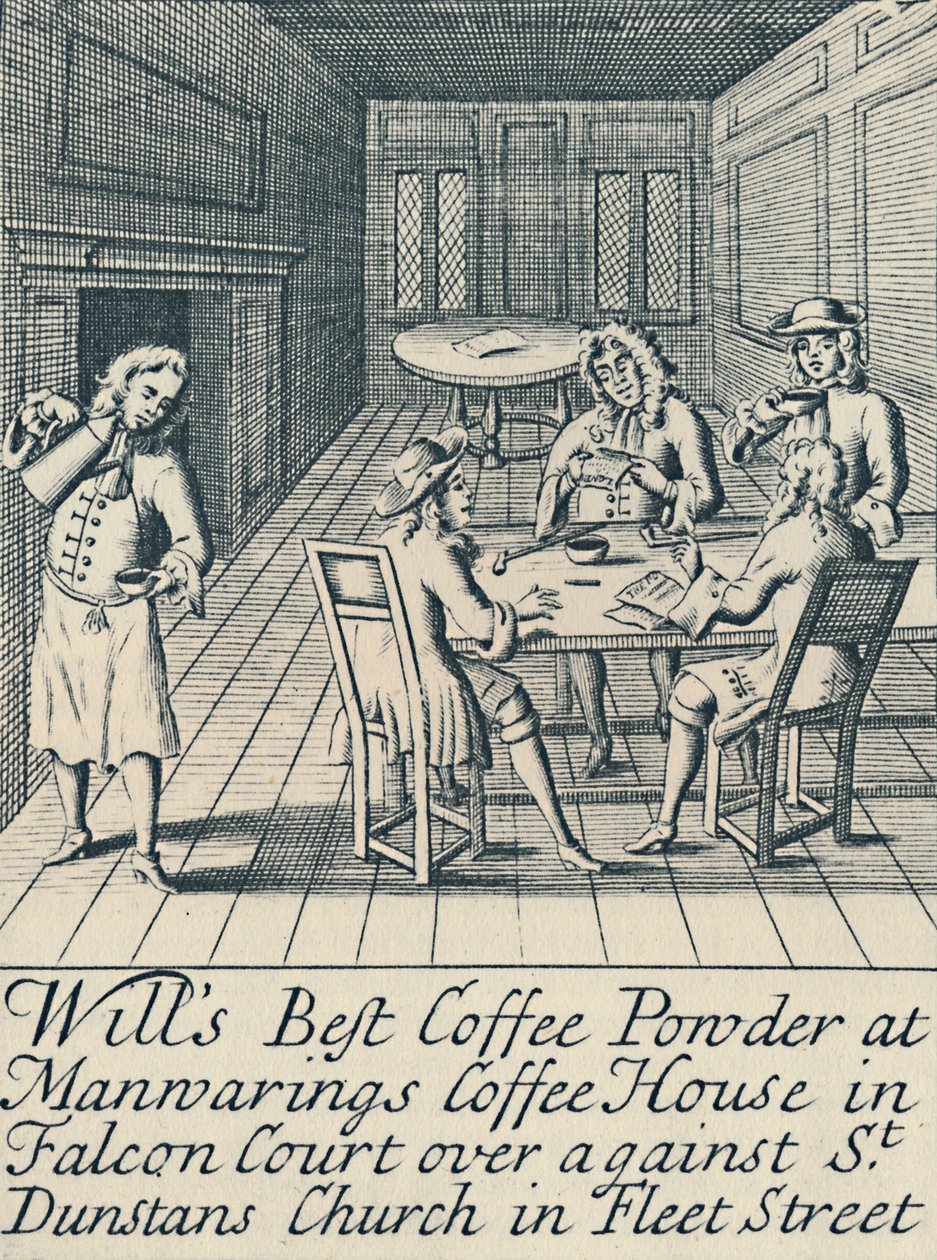
Broadsides, trade cards, playing cards and other print ephemera of the 17th century were "consumed" along with coffee and political gossip at a new type of establishment, the coffeehouse, that was spreading like pox (or Starbucks) across the face of London. Londoners of every class sipped the potent stimulant from abroad and sweetened it with gossip, little conspiracies of their own, newspapers, and gambling at hundreds of establishments such as Manwaring's, shown here on the left in a trade card. Its self-advertising caption pins it on William Morgan's 1682 map "London &c." at the number 92 in this map detail, just above Temple Church. Falcon Court is still there today.

📖 Reading
If you haven't read Scott McCloud's pathbreaking study Understanding Comics yet, this is as good an excuse as any! McCloud addresses the related principles of sequence and visual juxtaposition, with special attention to our "closure" of the gaps in between perceivable information. Here is Chapter 3 "Blood in the Gutter" (pp. 60-93), if you'd like to see the original. It is embedded from the Internet Archive, where it can be read for free.
🖥️ Activity
For the hands-on portion of our activity, we will learn a little through interactive exploration about broadsides and playing cards. Then we will try our hand at interactive historiography in a card game-inspired discussion.
The Rules are as follows:
- Round 1: each player (you) draws 2-4 image scenes from either broadside and/or playing cards, using the Mixtape deck and Cropping Tool and "plays" them in a post with brief commentary. You can select images already connected in sequence and mix and match as you please. Your commentary explains what you see of interest among these items.
- Round 2: after posting their own, every player reviews posts by other players, and looks for one to respond to, selecting and playing an additional new image or two from the broadsides or playing cards that somehow seem to connect with an idea, observation, or theme.
👓 Example
🧱 Materials
🪜 Steps
Individual v. multiple items Mixtape allows you to view, crop, and generate manifests for one item, selected items, or the whole collection, (click to open and close)
- To use individual or multiple items, check their tiles and click the desired function from the icons in the upper right corner
- To use the whole collection, check or uncheck the box in the upper right corner
Mirador (click to open and close)
- For individual items click to highlight the item card and lick the M icon in the upper right corner to load Mirador
- For comparative viewing, check the items you would like to see, and click the M icon in the upper right corner
- Click the +START HERE button in the upper left
- Then click the +ADD RESOURCE button on the lower right (the page may jump down a bit)
- Paste the manifest URI in the Resource location blank and click ADD. The item should load and display an item bar
- Click the item bar to load the item in the viewer
- Repeat for additional items
- Item windows can be dragged into different configurations using their header bar
- Zoom in and out, click through pages, and acclimate yourself to the many viewing settings, including thumbnail, single page, etc.
Cropping a IIIF image (click to open and close)
- Highlight items you would like to view and crop
- Select the Cropping icon
 in the upper right corner
 - Click page thumbnail in the left column to load in the IIIF Cropping Tool viewer
- Zoom and view
- To crop a detail from the image, click the white pencil icon, and highlight the desired rectangle by clicking and dragging a rectangle from corner to corner
- A thumbnail of your selected detail will appear in a slider at the bottom of the Cropping Tool. You can repeat to collect multiple details.
- Click the Copy icon
 on the left side of the thumbnail
Posting with an image (click to open and close)
- Click Reply
- To enter your image details, simply paste into the text field
- Images can be manually resized by highlighting and dragging their corners
- Repeat for additional images
✉️ Share
Round 1: draw a hand of 2-4 image panels (including connected ones) from the broadsides and/or playing cards in which you see any kind of interesting quality or relationship, and add brief (40-60 words) commentary to explain. As with cards, it could be value, similarity, or connection by sequence or association. Consider: how might we approach these items as "primary sources" in relation to historical events? How might people have read, looked at, handled, thought about, or been influenced by them? What are your impressions in comparison with other historical imagery, such as religious illuminations and scientific illustration? Remember, you don't have to solve a problem or answer a question correctly. You are sharing items and your observations.
Post no later than Saturday at 11:59pm (to give a chance for others to see and make a play on your hand)
🤝 Collaborate
Round 2: after you have posted your own hand, you will be able to see others' posts. Allow a little time if necessary, then review their images and comments to see if you have an item or two to add to one of theirs, with commentary (30-40 words). For those card sharps among you, this might play out like Gin Rummy, Go Fish or Texas Hold'em, where cards form meaningful combinations of sequence or similarity (e.g. pairs, flush, straight, full house, etc.) with posts by other players. It may be an idea or sentiment that catches your eye, or the same historical character, or event depicted somewhat differently. If nothing strikes you, choose a post that still needs response and hit it like an ace high on a pair of twos. Keep an eye on your own hand, meanwhile, and feel free to have the last word, once someone else has replied.
Interact by Sunday at 11:59pm