Curating Collections
 Students are introduced to the practice of "Ekphrasis" to practice "reading" an image/photograph.
Curating Collections

Let's talk about the elephant in the room. By the time Barnum and Jumbo's ABC was published, the popular pachyderm was long since stuffed and put on a pedestal, though it would be several years before its remains came to rest in a stationary exhibit at the P.T. Barnum Museum at Tufts University in Boston. Jumbo's giant footsteps from living spectacle to ephemeral information at a cultural heritage institution is exemplary of many lesser collected things, such as oddly shaped and tattered children's books.
See side show
Click here and be amazed by the world's biggest liar
.jpg) Until the 1880s, Phineas Taylor "P.T." Barnum, the Mayor of Bridgeport, CT and member of the Connecticut House of Representatives, was not really known as a circus guy, much less a politician. Barnum bought Scudder's American Museum in 1842 and reopened it as The American Museum. It had a bit of anything: beluga whales, Siamese twins, a flea circus, trained bears, and a 3-foot tall little person called General Tom Thumb. Confederate agents burnt the museum down in 1865, and most of the poor animals died in the massive conflagration. Its replacement, Barnum's New Museum, also burned down three years later.
Until the 1880s, Phineas Taylor "P.T." Barnum, the Mayor of Bridgeport, CT and member of the Connecticut House of Representatives, was not really known as a circus guy, much less a politician. Barnum bought Scudder's American Museum in 1842 and reopened it as The American Museum. It had a bit of anything: beluga whales, Siamese twins, a flea circus, trained bears, and a 3-foot tall little person called General Tom Thumb. Confederate agents burnt the museum down in 1865, and most of the poor animals died in the massive conflagration. Its replacement, Barnum's New Museum, also burned down three years later.
But we know P.T. Barnum from "The Greatest Show on Earth," Ringling Brothers, Barnum & Bailey Circus. Barnum lent his twisted business acumen to a growing craze, and brought his menagerie and sideshows on a modernized circus train to a rapidly expanding post-Civil War re-United States.
 Barnum's biggest stunt was his purchase of Jumbo, an African elephant, for $10K from the London Zoo in 1882. As far as celebrities go, Jumbo was the biggest of them all. He had been captured 20 years earlier in Sudan, and sold from Germany to France before landing in England. The British public adored him and didn't want to give him up. Once state-side, Jumbo quickly became the star attraction of Barnum's circus. Jumbo met his earthly end in early 1885 when he was struck by a speeding freight train. The show must go on, insisted Barnum, and he sent Jumbo's corpse off to Ward's Scientific Establishment in Rochester, NY to be stuffed and returned inside and out to the circus for posthumous labor.


There's more than one way to skin a cat, they say, but you'd better make sure it's dead. The cutter on hand at Ward's was Carl Akeley, who was about to disrupt the moribund field of taxidermy. From the Italian Renaissance Akeley developed an appreciation for flayed human bodies taking mannerist poses in sculpture and fresco. As for technique, from the French he borrowed papier-machet with shellac. Akeley's signature style can be seen in natural history museums across the land, such as The Field Museum. As for Jumbo, Barnum eventually donated his taxidermied remains to Tufts University in 1889 along with a (scientific) museum in his name. It burned down in 1975 and all that remains of Jumbo is a bit of trunk and his tail. 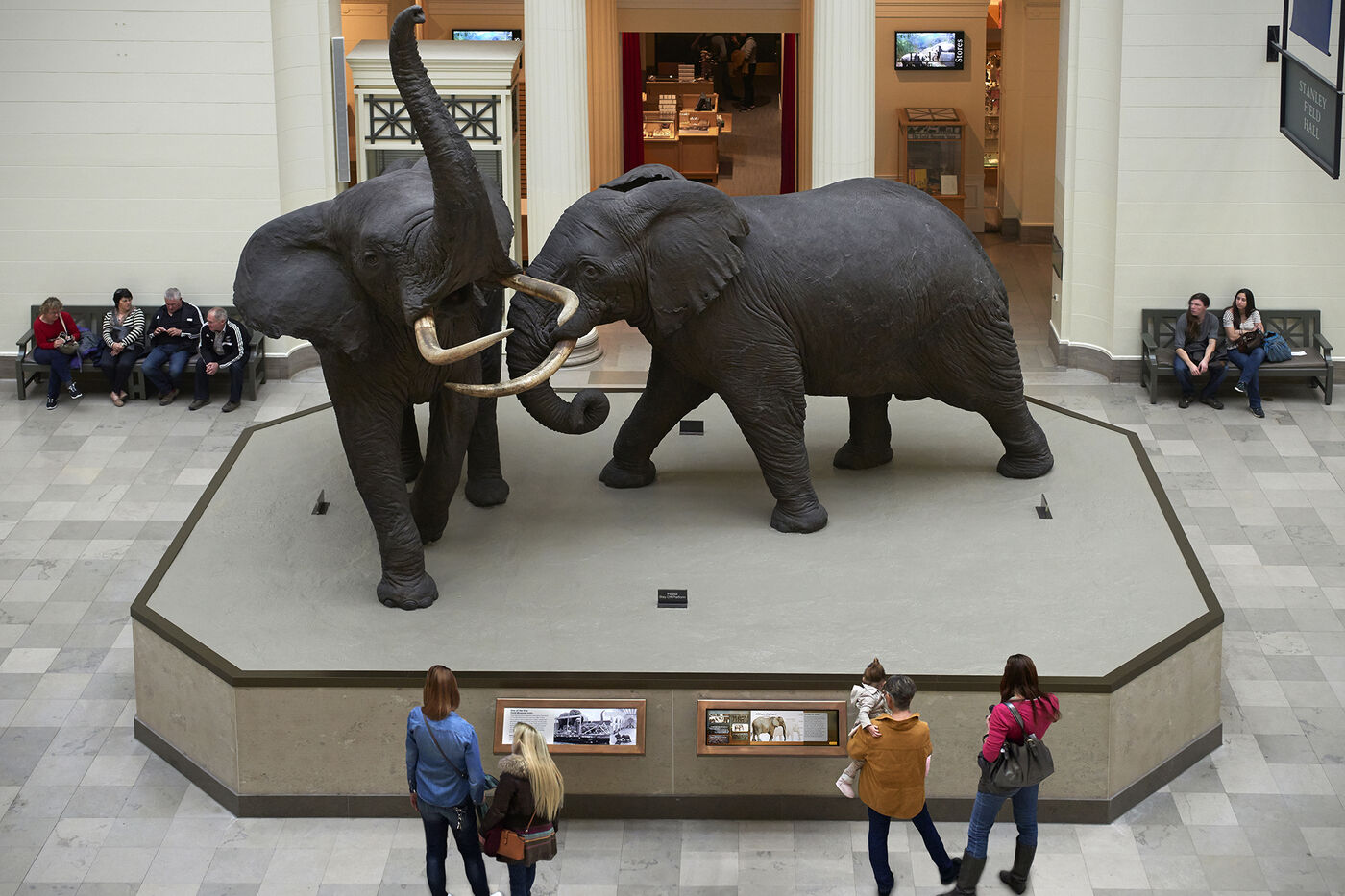
🖥️ Activity
We will exercise the curatorial practice of aggregating materials from disparate cultural heritage institutions using IIIF manifests and interoperability to contribute additional items to a thematic "teaching" collection about Jumbo the elephant.
- First, we will browse an online collection from a distant location
- Second, we will practice cutting, pasting, and posting mini-narratives made of image details
👓 Browse
👓 Browse
Though most of Jumbo's remains were lost in the 1975 museum fire, he left behind loads of ephemeral information. We scooped up some of it to rake through from The P. T. Barnum Digital Collection, which includes holdings of the Barnum Museum and the Bridgeport History Center, Bridgeport Public Library.
- P. T. Barnum Digital Collection (search term: Jumbo)
🧱 Materials
🛠️ Tools
🪜 Steps
Adding a IIIF item to Mixtape
To contribute an item to a teaching collection (click to open and close)
- Select item in a digital collection site
- Locate the IIIF icon or manifest link and click it to open the manifest
- Copy the manifest URL
- Paste the manifest URL in the Manifest URL blank in Mixtape, and click Add
Cropping a IIIF image
To select a portion of an image (click to open and close)
- Select the Cropping icon in an item thumbnail
- Click thumbnail to load in the IIIF Cropping Tool viewer
- Zoom and view
- To crop a detail from the image, click the white pencil icon, and highlight the desired rectangle by clicking and dragging a rectangle from corner to corner
- A thumbnail of your selected detail will appear in a slider at the bottom of the Cropping Tool. You can repeat to collect multiple details.
- Click the Copy icon on the left side of the thumbnail
Posting with an image
To add image details to a discussion post (click to open and close)
- click Reply
- to enter your image details, simply paste into the text field
- images can be manually resized by highlighting and dragging their corners
- repeat for additional images
✉️ Share
- Choose one item/image that you would like to focus on and open it in the Mirador viewer by clicking the M icon
- Then open your item in the Cropping tool and crop several details of that image
- Copy and paste those details in the reply and arrange them next to each other in sequence as a visual narrative
- Write a brief synopsis (summary) of the visual narrative
🤝 Collaborate
Once you have posted, take a look at what others have submitted, and feel free to leave a comment in reply