#HookedonFeathers
 ...
...
#HookedonFeathers
🖥️ Activity

This Lab Activity will support your individual and group work finding, selecting, and importing selected media from the Digital Florentine Codex (and other optional IIIF sources) into the course Scalar project Codex Chapman. Through metadata, you will ensure that your media is traceable back to its origin, and does not lose scholarly value along the way. And with #hashtagging, you facilitate the meaningful grouping, searching and browsing for collaborators and viewers.
🪜 Steps
Step 1
Develop lists of key terms (click to open and close)
- learn about tags, hashtags, and metadata in the Concepts section below
- view and consider Example of feather, below
- work in your groups and individually to identify key terms in the DFC and phenomena in the Nahau world related to your topic(s) and record in the Google Doc table
Step 2
Import Media (click to open and close)
- select items and item details you would like to use individually and/or for the group
- crop images with the IIIF Image Cropping Tool (below)
- import into course final scalar project Codex Chapman
- add metadata and #hashtags
Step 3
Build pages with media and add annotations (click to open and close)
- create individual project pages with dummy Lorem Ipsum text and add a few sample media items
- link selected media
- add annotations
- edit pages for design and layout
#tag
Tagging as "folksonony" (click to open and close)
The #hashtag is a recent invention. It was modestly proposed by a guy named Chris about 20 years ago. Here's how it started:
"How do you feel about using # (pound) for groups. As in #barcamp [msg]
-Chris Messina
Tagging didn't start with Chris Messina. It's been around for a long time. And hashmarks have too. But the combination of symbol and character string changed everything. A hashtag is attached to comments and media so readers can find message topics they are interested in. But you don't need us to tell you that. Everyone knows what a hashtag is. And that is its lure: hash-tagging is accessible to everyone. It converts taxonomy (the imposition of categories onto phenomena) into folksonomy (the popularization of taxonomy). In case you were wondering, the term "folksonomy" was coined by a guy named Thomas Vander Wal in 2004.
Metadata as tags
Get hooked on tagging (click to open and close)

Even farther back in time, at the dawn of evolution (the 1850s), tags were used to keep track of dead birds. Collectors of animal specimens from around the world, such as Alfred Russel Wallace, used actual paper tags tied with string to the legs of his taxidermied feathered friends to keep track of taxonomy, as well as date, location of origin and other information. Wallace was "the other Darwin," an adventurer contemporary of the famous evolutionary biologist who actually beat Charles to a theory of evolution by natural selection, but was since relegated to footnote status for most of us in favor of the established scientist.
Hashtags as Hooks
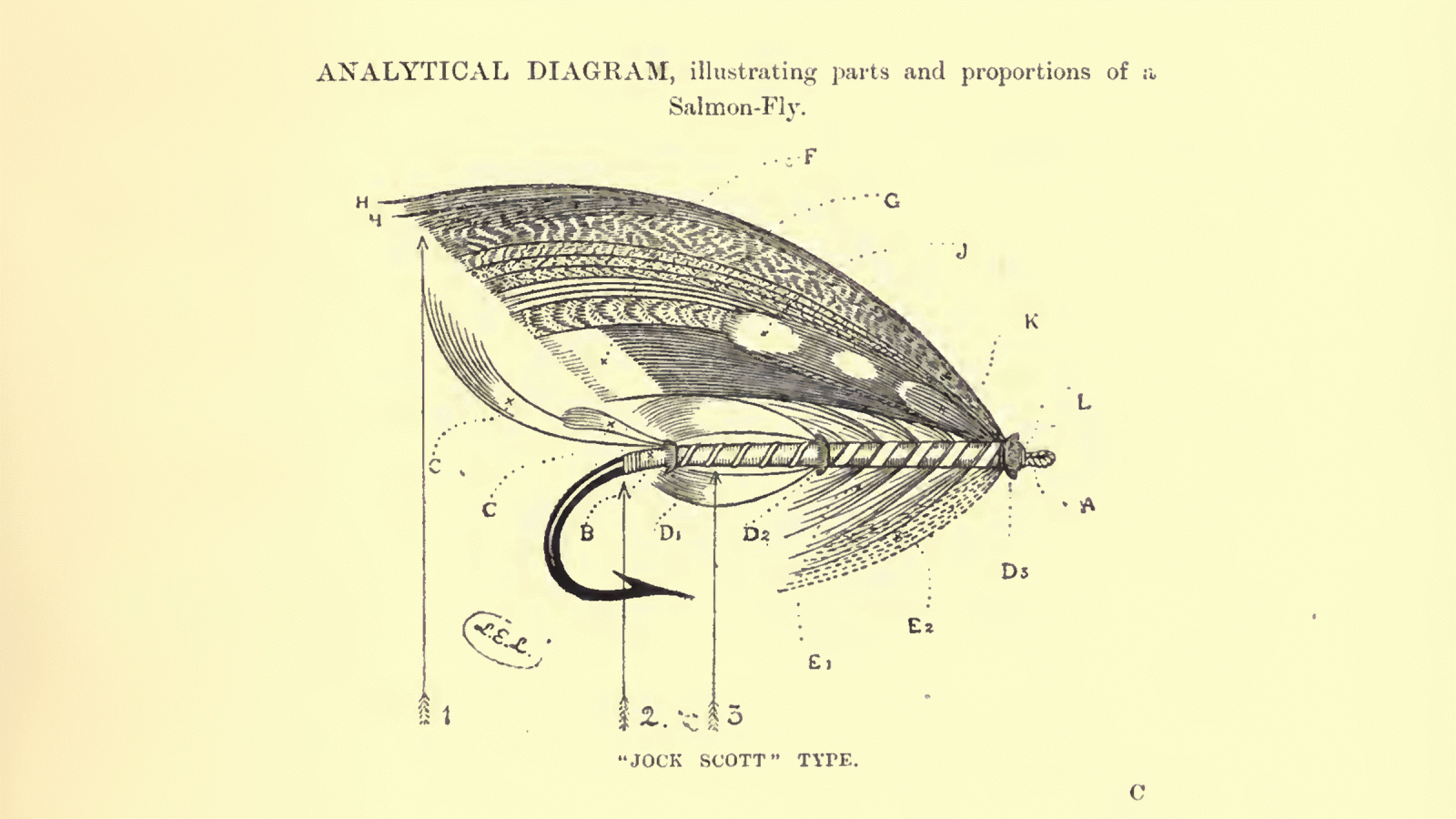
The function of hashtags as hooks into discursive streams also has historical precedent...
The Feather Heist (required)
Listen to a half-minute clip about tags from This American Life. (click to open and close)
So, how did we get from flying fish to fishing fly?
The Feather Thief's account of birds-with-metadata transforming into feathers-with-hooks is really a story about empire and trade. Commodities such as bird feathers derive their monetary, cultural, and/or scientific value from provenance: the tracking system by which people connect an item's current state in presentation to its point of origin. Like the salmon-fly, the hashtag has a business end (the hashmark), and the featherwork.
To summarize:
- tags connect specimens with metadata
- hashtags snag content and pull it into categories.
More about The Feather Heist (optional, but recommended)
Hear and read the back story of one of the must unusual crimes in the history of fly fishing. (click to open and close)
 A fish hook is supposed to catch fish. A salmon fly, made of a hook and fancy feathers, catches people.
The Feather Heist, from which the clip above was taken, is a podcast based on a true crime narrative of the 2009 break-in theft of Alfred Russel Wallace's bird skin specimens by a young musician and prodigy fishing fly-tier in need of money for a golden flute (seriously). Any outer resemblance of Edwin Rist's daring Tring Museum heist to Oceans 11 or Mission Impossible is overshadowed by the unforgivable scientific transgression of cutting tags off of birds and plucking their feathers to make salmon lures. We highly recommend, but do not require listening to the remainder of the podcast for your own personal edification. Alas, all we can reasonably ask you to do here is read a dialog from the transcript, look at the images above and below (from the author's website) and take from them the conceptual metaphor of the fancy, multi-part fish hook.
Trending fashionsThe book is called The Feather Thief, and its author, Kirk Johnson, is interviewed by host Sean Cole.
Kirk Johnson
Not long after, there was an industrialized slaughter all over the world. And it was in the name of women's fashion.Sean Cole
This was back when women wore a lot of hats. And anyone who was anyone wore hats with a lot of feathers on them, from parrots, egrets, ospreys. Designers in the US and Europe couldn't get enough of this stuff. Whole species were decimated by the fashion industry. You'd see hats decorated with entire birds.Kirk Johnson
In the 19th century, this was like the Gucci bag. If you could only afford a robin, that was one thing. But if you could afford a bird of paradise-- and we're talking about the whole bird being mounted with outstretched wings. And sometimes, these hats had several different birds mounted on them.Sean Cole
Holy crow. [LAUGHS] Sorry.Kirk Johnson
And it's-- I mean, it is punny, but it was how they demonstrated their own perch in society.Sean Cole
Some women had so many birds on their hats that they had to squat just in order to fit into their carriages-- so gaudy and inconvenient. Meanwhile, the gentlemen of the era were also sort of using feathers as accessories. Salmon flies were like hats for guys. This was also around the time that all these exclusive fishing clubs were popping up on the coasts of England and Scotland. And each club had its own special patented salmon fly. And the flies themselves had all these names.Kirk Johnson
They're absurd. They're like the Exordium, the Jock Scott, the Durham's Ranger. Can I-- I just wanted to--Sean Cole
Please.Kirk Johnson
Can I just--Sean Cole
Yeah, yeah.Kirk Johnson
Just to give people a sense of-- OK, so this is the recipe for the first salmon fly that Edwin ever tied. It's called the Durham Ranger. This is a recipe from the 1840s.Sean Cole
And they call it a recipe?Kirk Johnson
Yes. The tail calls for feathers from the Indian crow, which is the red rough fruit crow that's all over South America. The butt requires two turns of black ostrich hurl. The throat has light blue hackle, usually from the cotinga, which is from Central America. The wings have a pair of long jungle cock feathers with double tibbetts on both sides.Sean Cole
And it goes on like that. The cheeks are from a bird called a chatterer. The horns are blue macaw, which is a parrot.Of course, back then, when you wanted these feathers, you went down to the local plume merchant-- or in Paris a plumassier-- and you paid real money. Around the year 1900, certain snowy egret feathers were more expensive than gold.For historical perspective: Wallace and Darwin, two Englishmen, were working out and publishing the theory of evolution at the precise moment that England (with France and the United States) was waging the Second Opium War on Qing China (1856-1860). The biological-geographic expeditions Wallace made to collect specimens in the Amazon River basin (1848-1852) and the Malay Archipelago (1854-1862) were not just providing data for paradigm shifts in scientific knowledge. Like many such expeditions before them, they also generated accurate maps and tabulated data about flora, fauna, people, terrain, etc. that European imperialists would exploit to carve out plantations for valuable commodities and/or traffic indigenous populations for indentured labor. The "value" of Wallace's collections, in other words, is a complex calculation, and balances knowledge against human and ecological destruction.
👓 Example
Feather / Ihhuitl
Consider the example of The Feather in the Digital Florentine Codex (click to open and close)
As vocabulary in the digital edition, "feather" and one of its Nahuatl translations "ihhuatl" can be searched for either Text or Image returns. Depending upon which you select, nearly all books in the Florentine Codex are represented in the returns, and the variety of content associated with these search terms is astounding. It is easy to see, in this sense, how pervasive feathers are in Nahua history and culture. Here, the profession of feather seller as two types serves as a kind of metaphor for people in general.
 The feather seller is a feature worker, a merchant-the man [with] the basket.
The good feather seller [is] a gentle worker-one who esteems [his wares], who is dedicated. He sells various feathers-precious feathers; he sells fine green feathers, chili-green feathers, this curved at the tip, the feathers of young birds. He sells [feathers of the trogonorous, the troupial, the blue cotinga.
The bad feather worker [is] a [fraudulent] embellisher of feathers, a treater of feathers with glue. He sells old, worn feathers, damaged feathers. He dyes feathers; he dyes those which are faded, dirty, yellow, darkened, smoked.
Explore
Now look for yourself at some of the entries, and follow links to related terms below any image you view:
🧱 Materials
Digital Florentine Codex
The "FloCo" site is also embedded here for your convenience, but you are encouraged to link out to the site for best reading and viewing (click to open and close)
IIIF Manifests
Below are the respective IIIF manifest URLs for each book of The Florentine Codex, from the Bibiloteca Laurenziana. (Click to open list)
From The Getty Research Institute, Digital Florentine Codex, by volume
Books 1-4
https://media.getty.edu/iiif/manifest/ae8c3376-f8d6-447b-90a9-9c67b4cbe4d1
Books 5-9
https://media.getty.edu/iiif/manifest/3fa03fbc-a8c8-489e-83a5-1efc2d55fe5b
Books 10-12
https://media.getty.edu/iiif/manifest/d8a35385-d097-4306-89c0-1a15aa74e6da
🛠️ Tools
IIIF Cropping Tool
Use this tool to find the URI for an image in a IIIF manifest, and to crop a detail from that image (click to open and close)
Tip: make sure to select Full size before you Copy the URL!
Scalar media import
View Scalar 2 User's Guide instructions for importing linked media (click to open and close)
Additionally:
- For Title: use Nahuatl terms when possible, derived from image labels or accompanying text
- For Description: use English, Spanish, and Nahuatl to explain or describe what is depicted or represented in the media. Add any relevant #hashtags you decide upon within class and group discussions.
- Make sure to click Metadata either when you first import or edit, and add your item metadata to Source as follows:
Getty Research Institute, Digital Florentine Codex, Book [x], folio [x], [image URL]
Scalar individual page text
How to approach your 1500-word text for individual Scalar pages (click to open and close)
Think of this not as a traditional research paper that argues a thesis (“In this paper I will argue X…”). Instead, this is a visual research project in which you will explain images from the Florentine Codex in relation to Nahua worldviews and cross-cultural exchange on a particular topic. One way to think of this is to imagine that you are giving a tour of an exhibition of the images you have chosen, and are explaining how your visitors can understand how the images and text work together.
Tips
- Start by arranging your images in a particular order that makes most sense for your explanation of them.
- Do an in-depth visual analysis of each image. Describe what you see in each image, taking them apart piece by piece in a formal way, with the goal of revealing the multiple dimensions of the images as both image and a form of text.
- After your visual analysis, analyze the textual passages and consider when the various texts might add to your contextualization. Make sure to consider the prompts posted above.
- When possible, focus your attention on the Nahuatl passages first, and then move to the Spanish text. Given that our class is dedicated to thinking about Indigenous forms of knowledge, think carefully about the importance of Nahua worldviews expressed in key terms and ideas in the text.
- Have a conclusion that wraps up the ideas from your discussion of the individual images and texts.
Note on Annotations
Your annotations can come from your 1500-word text, they don’t necessarily need to be separate texts. Think of a magazine spread or blog post, where images are explained by quotations from the accompanying text.
Citations
Please include at least 3-5 citations in your 1500-word text. Using Chicago Manual of Style, please use an “author-date” in-text citations as you write and include a list of works cited at the end of the text/
Example of in-text citation
“In thinking about this image, I am considering the Nahua concept of ixiptlah as discussed by Magaloni-Kerpel (Magaloni-Kerpel 2014, 12).”
Example of work cited (reference list) at the end of text
- Magaloni-Kerpel, Diana. 2014. The Colors of the New World: Artists, Materials, and the Creation of the Florentine Codex. Los Angeles: Getty Research Institute.
If you are drafting text outside of Scalar
- If you are pasting in text, click Source in the upper left corner first (to ensure you don't import unwanted text coding), then click again to edit
- Also, make sure to edit your own page, and not the home page of the Scalar project, when you click the pencil edit icon!
Scalar page editing
View Scalar 2 User's Guide instructions for adding media and annotations to a page of text (click to open and close)
Remember:
- .Follow directions for adding media to your own page. Make sure to select Title and Description, and Wrap Text settings.
- Any annotations you have made will have to be selected to appear on a page (see bottom of this page in User's Guide)
🖥️ Project
Scalar Class Project
View Codex Chapman (view only / editing won't work from here) (click to open and close)
🤝 Collaborate
Google Doc worksheet
Keep an updated inventory of key terms, links to media and project ideas. (click to open and close)
✉️ Share
This Lab Activity is intended as a resource page for supporting media import. It will also serve as a discussion post for sharing and refining key concepts that can be used as #hashtags for select media and other Scalar content. The true art of hashtag-tying is both individual and collaborative. In separate posts to this discussion, working individually, share 3-5 hashtags and their "recipes" (brief explication). Take your time: although small in form, these require attention to topics you have searched, and some thought about what attracts you in the subject matter. In designing and defining your hashtags, consider how effective it might be in its intended purposes of:
- attaching to multiple items for comparative study
- connecting examples with important ideas and facts
Post 3-5 hashtags with their recipes
As a follow-up, review and reply to posted hashtags and recipes by your peers, "liking" items that you think should rise to the top for general use. Point out any similarities or correspondences with others, including your own, and if necessary, suggest merging or reconciling hashtags that are too close in meaning for comfort.
The first "Due Date" for this Lab Activity is [ ]
Post additional hashtags continuously as you create them respond to peers' submissions simultaneously.