Scaly Swimmer
 ...
...
Scaly Swimmer
Scalar

| Spanish-to-English Translation (Garcia Garagarza 2023) | Nahuatl-to-English Translation (Anderson & Dibble 1953-1982) |
| They call the Tulla river Tullanatl, which means “river of Tulla,” because it passes through the middle of the town. Its water is somewhat blackish. It is stony and muddy, for it has many stones and a lot of slippery mud. It runs with great force, and the river often drags downstream those who cross over it. |
Tollan atl Its name is from the city of Toulon and atl [water], because it passes within the city of Toulon. It is a little dark, a little black; it is rocky, with slippery rocks; an engulfer of things, a carrier of trees, of rocks. I drown; it carries me off, it drowns me; it is winding |
Scalar
So what, exactly, is a Scalar?
In mathematics, a scalar is one of two or more values that define a vector. Vectors can be used to understand worldly problems, such as how to cross the Tollan atl river. To reach a point directly opposite on the far side and not get carried away and drown, a swimmer must aim for a point upriver (v). Thus the actual distance swum is greater than the distance across (y), and the actual direction is at a diagonal, once one accounts for the current of the river .
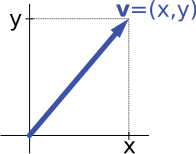
In the early modern history of the Digital Humanities (about a decade ago), Scalar was launched as a digital authoring tool to expand capacity for scholarly multimedia publication by the design and editorial team of Vectors, an online digital scholarly journal. The tool outlived the journal, which once featured a playful interactive scribbling device for drawing one's own pathway through content, before the underlying web technology became obsolete (here is what's left of it).
The mathematical concepts that inspired the names of these digital environments may seem simple in comparison with the big ideas they exemplified: the "semantic web," for example, which is only now beginning to realize its early vision.

The concept we will use as a starting point here for understanding Scalar relates in a way to the mathematical scalar as a value that is both important in itself (a scalar), and important to the extent it intersects with other values (a vector). For example:
- An image is important in itself; in relation to another image, or set of images, it takes on a new significance
- Text provides information about a topic; media represent subjects; in combination, media and text comprise a synthetic product.
Scalar is an online scholarly authoring platform designed on the concept of a book. It allows you to present media alongside text as exhibits for readers to see for themselves. And it helps you use exhibits as evidence in support of your argument or thesis through comparative analysis and annotation. We could approach Scalar the easy way and say: it's a website. We are going to approach it from the other side and say: it's a relational data structure that will help us think about the history of Tenochtitlan and the Florentine Codex in interesting ways, if we don't drown.
Look for yourself at the "About Scalar" page on the ANVC website, look at the graphics, and think about the bold proposition that "anything can do anything to anything." What do you think that means?
Site Registration
Register
Chapman has its own instance of Scalar (the public instance is hosted by USC).
To register for Scalar, fill out the Scalar Registration form (also embedded here).
- Use the Registration Key ChapmanPanthers2835
- Enter your name as you would like it to appear as an author/collaborator in a public-facing project.
- You can use any password of your choosing (not your Chapman password).
Post Your Username
As soon as you are done registering, reply to this post and write or paste your name just as you registered it in Scalar. This is important, as it will allow us to find your account name and add you to the class Scalar project.
Sample Content
Scalar Book (Splash Page)
This is the live (practice) Scalar book that we will use to learn the features of the platform and develop proficiencies and best practices of media import, annotation, etc.
Sample Student Page
This is what a simplified student essay in Scalar might look like, with dummy "lorem ipsum" (fake Latin) text and one annotated image with metadata imported from a digital source.
Widgets
This page contains a sampler of "widgets" Scalar offers to display content in different ways, such as map, visualizations, and timeline. These can be created using media imported with the right kinds of metadata, such as geographic coordinates and dates.
Digital Florentine Codex
DFC Site
Access the DFC embedded here or at the link below for quick access to image and text content and search.
DFC IIIF Manifests
IIIF Manifest URI's
Here are manifest URI's for each of the three volumes of the DFC.
From The Getty Research Institute, Digital Florentine Codex, by volume
Books 1-4
https://media.getty.edu/iiif/manifest/ae8c3376-f8d6-447b-90a9-9c67b4cbe4d1
Books 5-8
https://media.getty.edu/iiif/manifest/3fa03fbc-a8c8-489e-83a5-1efc2d55fe5b
Books 9-12
https://media.getty.edu/iiif/manifest/d8a35385-d097-4306-89c0-1a15aa74e6da